Does Beef Tallow Help Sunburn?
No study shows beef tallow treats sunburn.

Editor’s note: This article was rewritten and updated in November 2026. It replaces our original April 2025 article at this address.
Beef tallow sun protection is a popular search, and the short answer is no. Plain beef tallow is a moisturizer. It has no tested SPF, and no published study shows it shields skin from ultraviolet light. A 2024 scoping review in Cureus found only a handful of studies on tallow and human skin at all.
Tallow leaves a visible sheen, and people who use it often say their skin feels comfortable outdoors. Comfort and protection are two separate things. Skin can feel soft and still be taking in ultraviolet light. A tan or a burn is the evidence of that exposure, whatever was on the skin at the time.
In the United States, sunscreen is regulated as an over-the-counter drug. The FDA recommends a broad spectrum sunscreen with an SPF of 15 or higher. Apply it 15 minutes before you go outside and reapply at least every two hours, more often when you swim or sweat. Shade, long sleeves, a brimmed hat and sunglasses carry part of the load too.

A real sunscreen carries a Drug Facts panel that names its active ingredient, such as zinc oxide, along with an SPF number. “Broad spectrum” means the product passed testing for both UVA and UVB. Check those three things on every sun product you buy, including ours. Our mineral option, Sun Shield, lists zinc oxide on its product page. The label on the jar is the final word on SPF and directions.
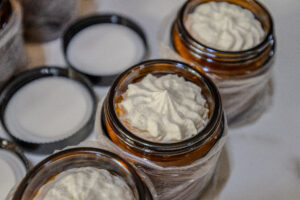
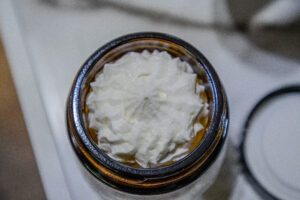
Sun, salt water and wind dry the skin. A tallow moisturizer such as Simply Whipped is useful in the evening, after a rinse, on damp skin. In the morning, moisturize first, let it settle, then apply sunscreen as the last step before you head out. Our article on how to use tallow balm covers amounts and timing.
Mixing zinc oxide into tallow at home does not give you a known SPF. Sunscreen has to be tested as a finished formula, because protection depends on how evenly the mineral is spread. We suggest leaving sunscreen to tested products.
For the full kit, see our beach day skincare packing list.
Sunlight reaches your skin as two kinds of ultraviolet light, UVA and UVB. The SPF number on a label relates to UVB, the rays most tied to burning. “Broad spectrum” tells you the product also passed testing for UVA. The FDA advises choosing a sunscreen that carries both: broad spectrum and SPF 15 or higher. A moisturizer of any kind, tallow included, has been tested for neither.
Sunscreen is one part of sun safety. The FDA also recommends clothing that covers exposed skin, such as long-sleeved shirts, pants, sunglasses and broad-brimmed hats. Shade during the middle of the day lowers exposure further. On the water and on sand, light bounces back up at you, so cover the underside of your chin and nose as well.
Charts that assign SPF values to oils and fats circulate widely. They rarely say how the number was measured, at what thickness, or on whose skin. SPF on a sunscreen label comes from standardized testing of the finished product. A number attached to a raw ingredient, with no test behind the product in your hand, tells you nothing you can rely on at noon on the beach.
Sunscreen active ingredients fall into two broad groups. Mineral filters, zinc oxide and titanium dioxide, are the ones many shoppers with a short-ingredient-list preference look for. Other filters are often called chemical sunscreens. Both kinds are regulated the same way and both carry a Drug Facts panel. Whichever you pick, the label is where you confirm broad spectrum coverage, the SPF value and the directions. The FDA explains how to read each part.
Most people use less sunscreen than the label assumes. The FDA’s guide for an adult is about one ounce for the body, roughly a shot glass. Work in sections so nothing is missed: face and ears, neck front and back, each arm, chest, back, each leg, tops of the feet. The FDA specifically names the nose, ears, neck, hands, feet and lips as areas to cover. Ask someone to do your back.
No sunscreen is waterproof. Labels may say water resistant for a stated number of minutes, and after that you start over. The FDA says to reapply at least every two hours and more often when you are swimming or sweating. Toweling off removes product as well. A phone alarm is the simplest tool for remembering.
Dry, tight skin is uncomfortable, and comfortable skin makes it easier to stick with good habits. A thin layer of moisturizer on damp skin in the morning gives sunscreen a smooth surface to spread on. Let it settle for a few minutes first. In the evening, after you rinse off salt and sunscreen, a richer layer of Simply Whipped or Simply Whipped XL eases the dryness that sun, wind and water leave behind. That is the role we recommend for tallow: before and after, never instead.
Sun exposure adds up on ordinary days: the school pickup line, yard work, a walk at lunch, the drive home with the sun on your arm. The FDA recommends broad spectrum sunscreen even on cloudy days. Keeping a tube by the door, next to your keys, makes it part of leaving the house. A hat that lives in the car covers the days you forget.
Every skin tone can burn and every skin tone is affected by ultraviolet light. The FDA notes that fair-skinned people are likely to absorb more solar energy than dark-skinned people under the same conditions. That is a difference of degree. The advice to use shade, clothing and broad spectrum sunscreen applies to everyone.
Use the same checklist on our Sun Shield and on any other brand in your bag. If a sun product has no Drug Facts panel and no SPF, treat it as a moisturizer.
We love what tallow does for dry skin. We will not tell you it protects you from the sun, because nothing published supports that. Use a tested sunscreen for the sun and a moisturizer for dryness, and your skin gets the benefit of both.
Tournaments, fishing trips, theme parks and yard projects all run longer than planned. Pack more sunscreen than you think you need and put a spare in the car door pocket, out of direct sun. Wear the hat from the start instead of adding it once your scalp feels warm. Take shade breaks on a schedule, tied to something regular like every other inning or every refill of the water bottle. Look at your shoulders, nose and the tops of your ears in a mirror at midday. Pink skin is the signal to cover up and move into the shade for the rest of the afternoon. In the evening, rinse, moisturize and take note of the spots you missed so tomorrow’s application covers them.
No tested SPF value exists for plain tallow. Treat any number you see online as a guess.
Yes. Apply a thin layer, give it a few minutes, then apply sunscreen generously on top.
It can ease ordinary dryness. For an actual burn, read does beef tallow help sunburn.
Zinc oxide is a sunscreen active ingredient. A product is a sunscreen once the finished formula has been tested and labeled with an SPF.
This article is general information, not medical advice. See a board-certified dermatologist about any skin concern.

No study shows beef tallow treats sunburn.
Plain beef tallow is a moisturizer and
Tallow skincare is moisturizer made from rendered
A pea-sized scoop on damp skin is